Lab Recycling
Labs currently participating as of November 2010:
- Boyer
- Caplan
- Cresswell
- Fahmy
- Krause
- Levene
- Lin
- Qiu
- Saltzman
- Shulman
- Strobel
- State
Q: What is a recycling lab?
A recycling lab is a lab whose members have formally committed to recycling. Included in the lab recycling package are:
- A short presentation with info about recycling specifically for labs
- Recycling stickers for your lab
- A recycling contract
- A personal recycling liaison
Q: How can my lab become a recycling lab?
Contact the Head of Yale Recycling, C.J. May, either by e-mail (cyril.may@yale.edu) or by telephone (203.432.6852).
Q: How does a Recycling Lab recycle its materials once it has received training and signed on?
- Lab members place designated items in a specially-labeled bin or box in the lab. They place most items directly into the bin/box. For a few specified items they triple rinse, air dry and deface labels.
- One designated lab member checks all items in the bin to ensure compliance with regulations and Recycling Lab protocol.
- The designated lab member then empties the items into the recycling cart in the hallway for removal by custodians.
Q: What lab-specific items can be recycled?
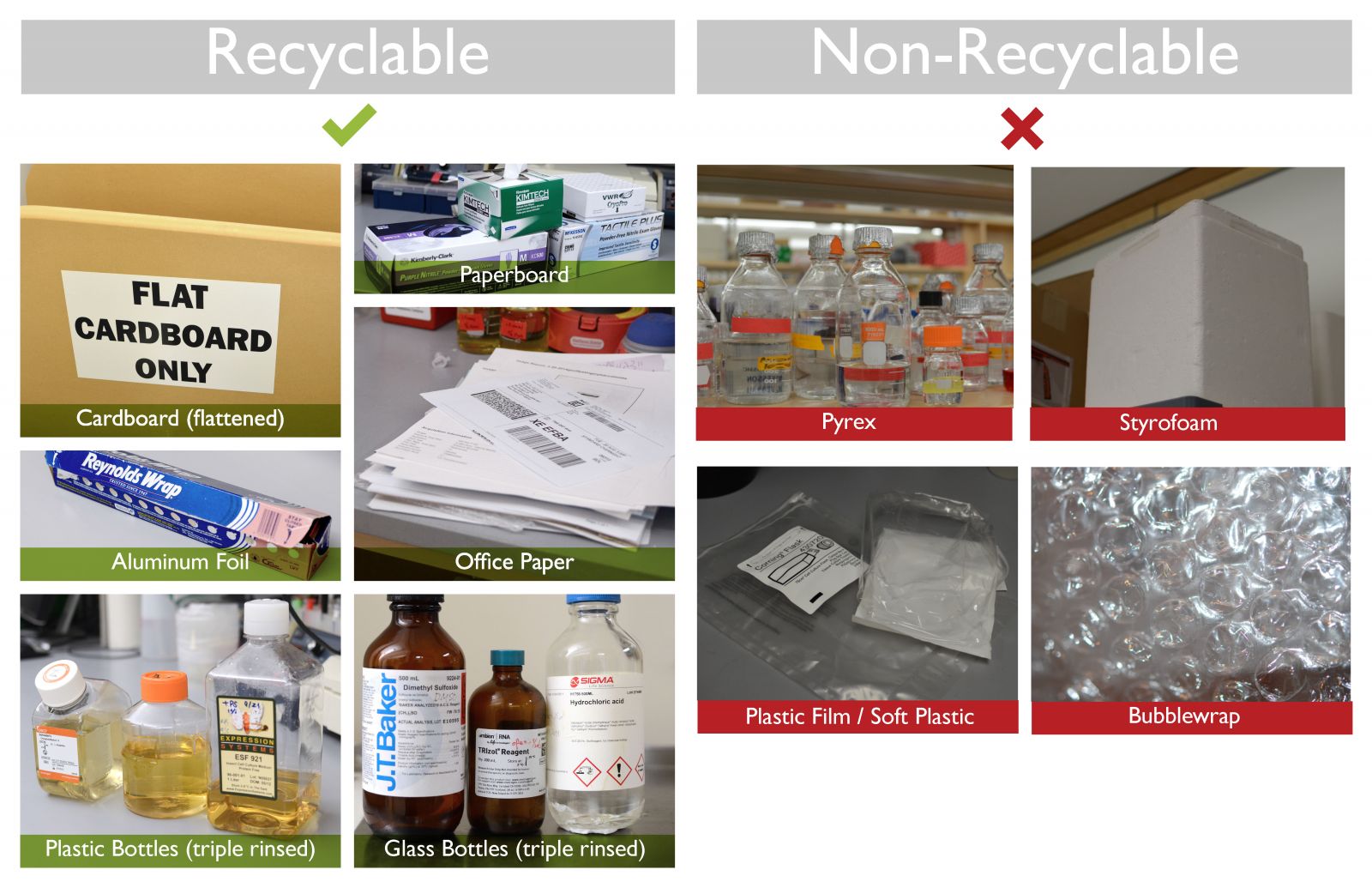
- Pipette tip boxes
- Aluminum foils & trays
- All glass, plastic or metal containers that are triple rinsed and defaced that once contained liquid chemicals can be recycled. (Exceptions include any acid, base or acutely hazardous chemical container. Plastic safety coated glass bottles cannot currently be recycled.)
Q: What regular items can be recycled from labs
- Paperboard boxes (e.g. glove boxes)
- Corrugated cardboard
- Paper: Color, white, glossy, hard and soft cover books, envelopes (even with windows)
- Batteries: Request pick up at www.yale.edu/ehs/wasteuw
- Electronics (e.g. computers): Request pick up at www.yale.edu/ehs/wasteuw
- Usable Supplie (e.g. office supplies): Request pick up from Recycling by contacting Customer Service at centralcsc@yale.edu or (203.432.6888)
Q: What can we not recycle?
- Pyrex
- Items with biological, radiological or chemical materials
- Sharps
- Rubber Gloves
- Block foam (e.g. "styrofoam")
- Items not specified as recyclable
- Rubber coated chemical bottles
- Plastic safety coated glass bottles
- Any acid, base or acutely hazardous chemical container
Q: What happens to solvents?
All solvents currently are bulked into 55-gallon drums and sent off-site for disposal through incineration. The incineration process is used to fuel cement kilns. A few departments in the medical school have purchased their own solvent recycling systems and can recycle ethanol and xylene for reuse.